





Drift King — The Complete Guide
Drift King is a free browser drift game with a tuning sim under the hood. You start with 30,000 credits, an Audi TT, and a fully customizable garage. From there it splits in two directions — one is a drift game where you're chasing combo scores down mountain roads, and the other is a tuning workshop where you're tweaking suspension geometry, brake balance, and camber until the rear end breaks loose exactly the way you want. This guide covers both halves: the controls, the drift mechanics, the tuning, the cars, the maps, and the specific things that take a few sessions to figure out.
Quick start — what to actually do with your 30,000 credits
Most car games make you grind. Drift King hands you 30,000 credits before you've turned a wheel, which is enough to buy almost any car except the top three. This is the most common place new players get it wrong: they immediately spend everything on the most expensive car they can afford and then have nothing left to upgrade it. A stock 25k car drifts worse than a fully-upgraded 14k car. Almost always.
The optimal first-session play:
- Stay in the free Audi TT for the first 5–10 minutes. Learn how the controls feel, get used to the camera, try a couple of maps.
- Then buy the Nissan IDx Nismo Concept (14,000 CR) or the Toyota GR Supra A90 (17,000 CR). Both are rear-drive, modestly powered, and forgiving. The Supra is the better long-term car.
- Spend the remaining ~13,000–16,000 CR on engine, gearbox, and weight reduction upgrades for that car. Don't spread upgrades across multiple cars early.
- Skip the supercars (Ferrari F12, Porsche 918, Aston Martin Vulcan) until you've actually learned to drift. They're brutal to drive cold and you'll spin every corner.
Controls — every key, including the obscure ones
Drift King uses standard arcade-driving keyboard inputs plus a few extras most players never discover.
- W / Up Arrow — accelerate
- S / Down Arrow — brake; hold past zero to reverse
- A / Left Arrow and D / Right Arrow — steer
- Space — handbrake (e-brake). The most important key in the game. Tap, don't hold.
- Left Shift — nitro. Limited reserve. Use it on straights to top up your speed before the next corner — wasting it mid-drift just spins you.
- C — change camera angle. Cycles through chase, hood, bumper, and cinematic views.
- R — reset to track if you crash, beach the car, or fall off.
- I — start / stop the engine. Mostly cosmetic, but useful if you want to roll silently.
- M — enlarge the rear-view mirror. Genuinely helpful in multiplayer when you want to see who's chasing you.
- B — toggles the rear-view from the hood. Different angle than M.
- P — fullscreen.
Touch controls work on phones and tablets — there are on-screen pedals, a steering wheel, and a handbrake button. The keyboard is significantly better because handbrake-tap timing is the entire game and thumbs aren't fast enough.
How drifting actually works in this game
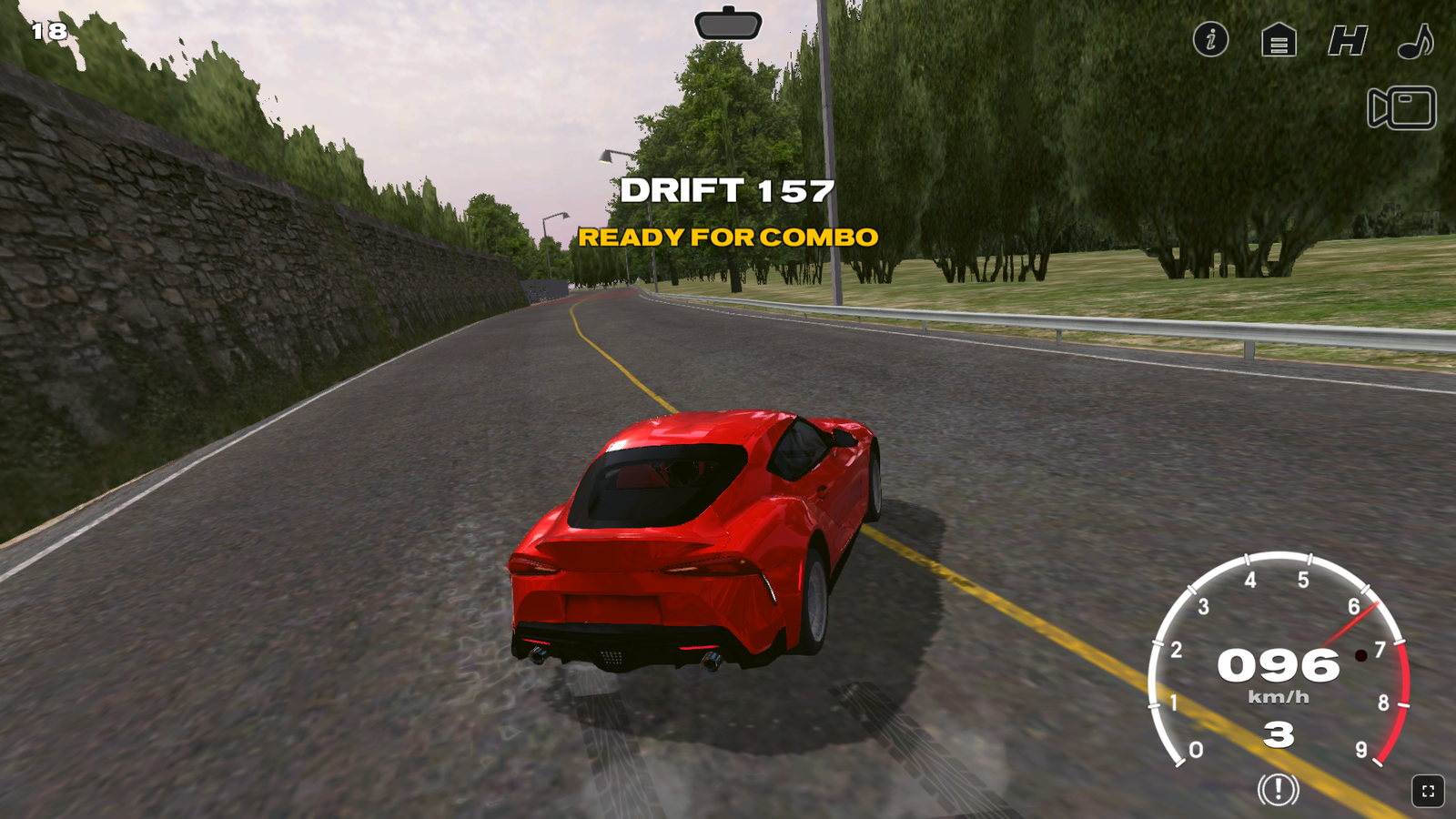
The score system is built around two concepts: the drift counter and the combo system. As you slide, you see a "DRIFT" number ticking up — that's your current slide's points, accumulated based on slide angle, duration, and speed. When you finish a drift cleanly (without spinning, crashing, or fully straightening), you'll see READY FOR COMBO appear. If you initiate a new drift within about a second, the next drift's points get multiplied and added to your running combo total. Chain four or five together and the score climbs fast.
The two ways to initiate a drift:
- Handbrake initiation. Approach a corner, tap Space briefly while turning. The rear wheels lock, the back end steps out, you release the handbrake, stay on throttle, and counter-steer to hold the slide. Works on every car.
- Power-induced (throttle) drifts. On any rear-drive car with a few engine upgrades, you can break traction just by mashing throttle mid-corner — no handbrake needed. This is how leaderboard players chain combos without the rhythmic handbrake-tap that breaks new players' inputs.
The thing that actually holds the drift is countersteering. Once the back end is sliding right, steer the front wheels left to keep the car pointed roughly down the road. Too much countersteer snaps you back into a grip turn. Too little and you spin out. The sweet spot is about 20–30 degrees of opposite input, modulated continuously. The game's physics rewards small constant adjustments more than big aggressive corrections.
What breaks a combo: spinning, hitting a wall hard, coming to a stop, going completely straight for more than about a second, or slamming the brake. What doesn't break a combo: switching drift direction (left-slide to right-slide is actually where the bonus points come from), light wall scrapes, or briefly straightening between two corners as long as you re-initiate fast enough.
The 6 maps and what each is best for
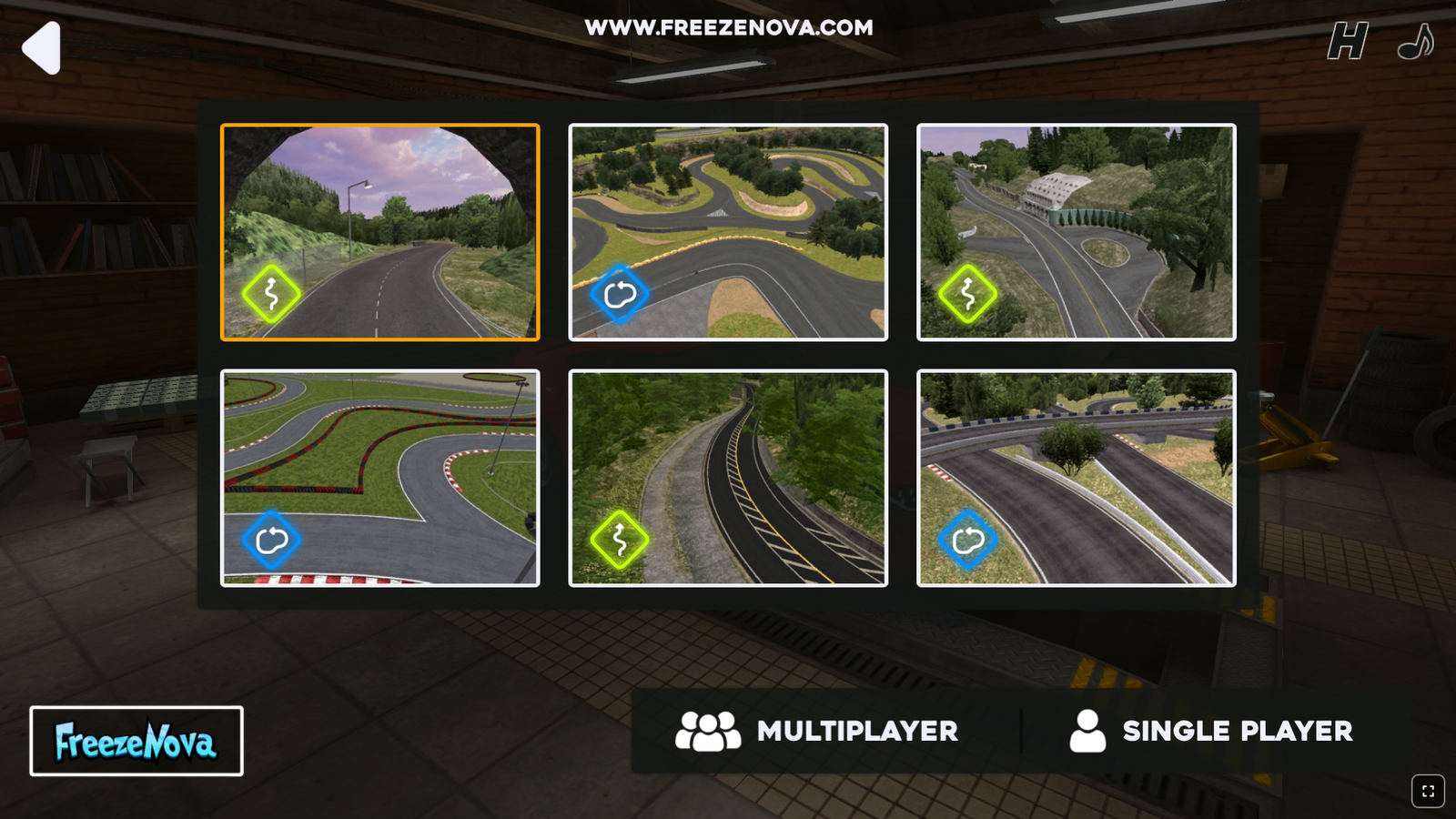
The map selection screen shows six environments. They split into two categories indicated by the icons: the green lightning maps are drift-focused free-roam roads, and the blue heart maps are more racetrack-style circuits.
- Mountain Pass (drift-focused). Long sweeping curves, big elevation changes, scenic. Best for learning the basics — wide margins of error, room to recover from a botched drift. Most beginners should start here.
- Touge Road (drift-focused). Tighter, more technical. Good once you're comfortable initiating drifts and want to chain them through hairpins.
- Highway / Expressway (drift-focused). Long straights with sweeping bends. The best map for top-end speed runs, nitro chaining, and freestyle long-form drifts. Less technical but high score potential.
- Drift Track (track). Closed circuit designed for drifting — linked corners, kerb-friendly layout. Use for combo grinding and personal-best chasing.
- Country Loop (track). Mid-speed circuit with a mix of corner types. Good for testing tuning changes because the variety shows you what your car can and can't do.
- Industrial / City (track). Tighter circuit with walls. The walls let you "lean into" slides — light contact extends drifts rather than ending them. Risky but high reward.
One unusual feature: the racetracks aren't locked into a single direction. You can drive them in reverse, explore the paddock, the pit lane, the workshops — basically anywhere on the map. This is great for multiplayer freestyle sessions but also for finding lines other players haven't tried.
The garage — Upgrades, Paint, Tuning, Wheels
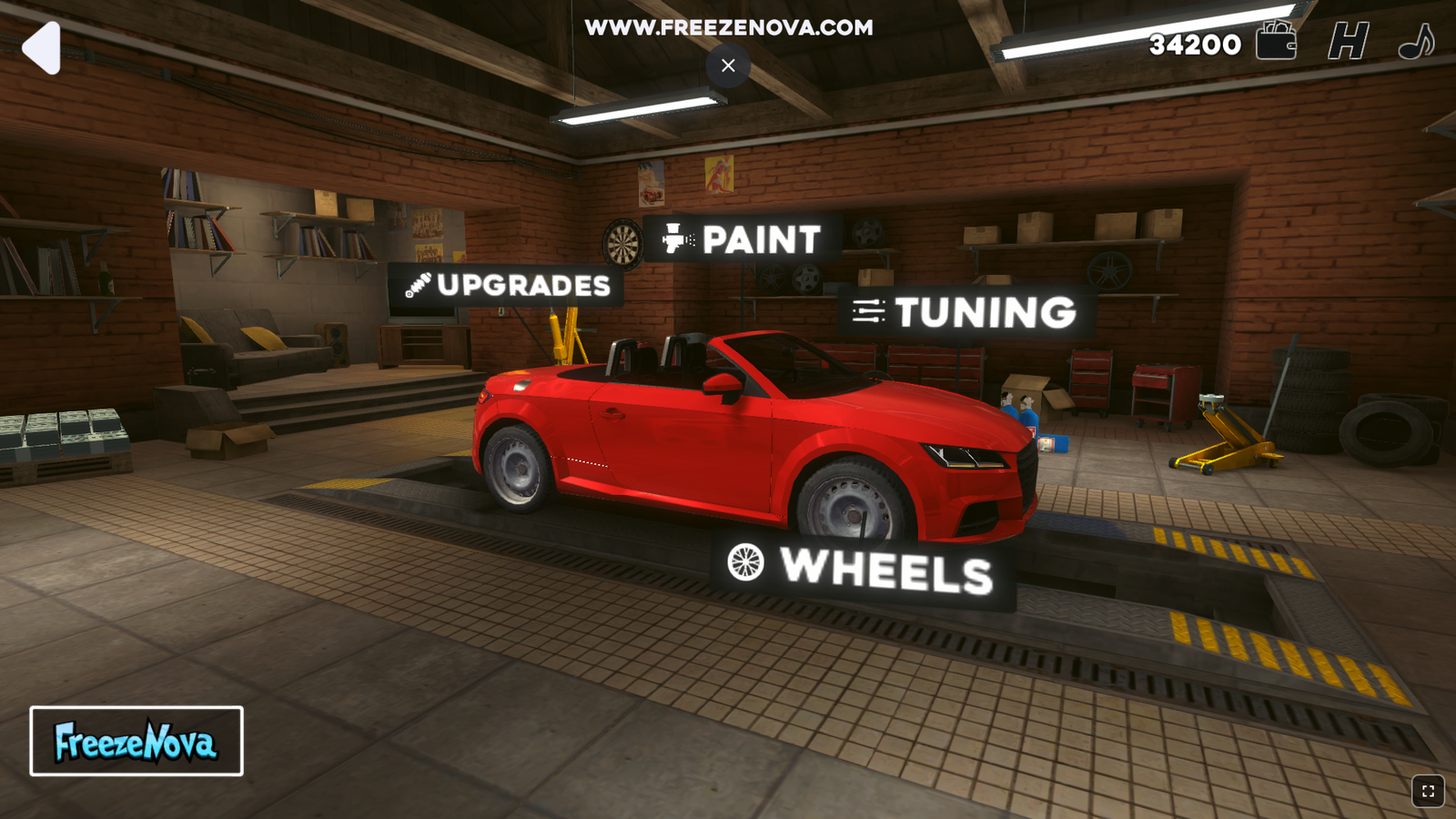
The garage has four sections. Each does a different thing:
- UPGRADES — performance modifications. Engine, turbo, gearbox, weight reduction, handling. Each has 4 tiers and (unusually for the genre) the price doesn't increase per tier — every tier costs the same flat amount. This means full-tier upgrades on a single car are the right strategy; partial upgrades across multiple cars are wasteful.
- PAINT — cosmetic only, costs about 150 CR. Doesn't affect performance, but customizing your car helps in multiplayer because everyone starts with the same color schemes.
- TUNING — free suspension and brake adjustments. This is where the depth lives. Detailed below.
- WHEELS — costs around 2,000 CR for a new set. Pure cosmetic. Save for later.
Priority order, especially early game: Upgrades first (engine and weight first, then gearbox, then handling), then start playing with Tuning, and only worry about Paint and Wheels when you're flush with credits.
Tuning — actual slider recommendations
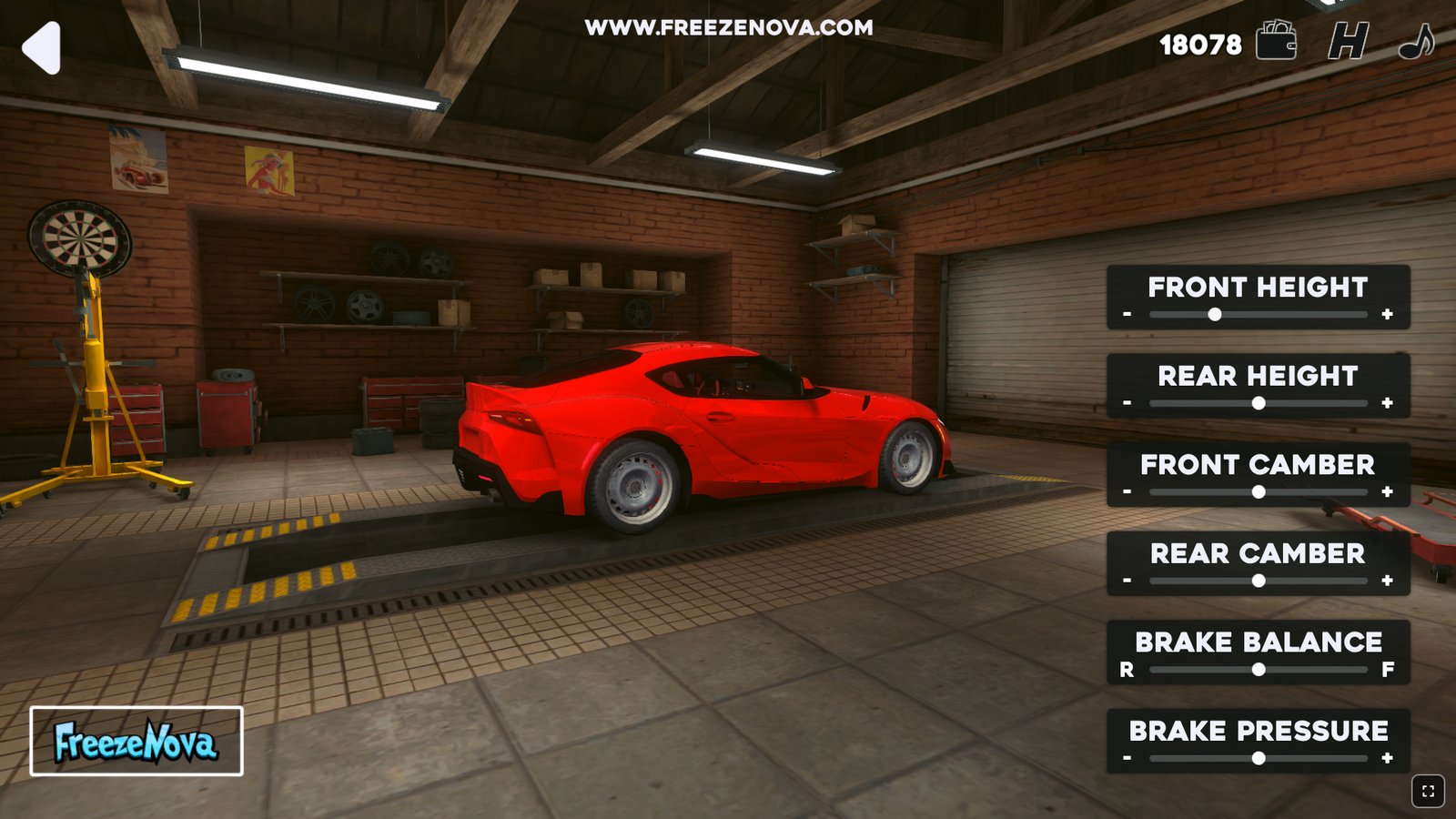
The tuning menu has six sliders. Most players ignore them entirely or randomize them and decide tuning is too complicated. It isn't. Here's what each one does and where to set it for a drift-friendly setup:
- Front Height — how high the front of the car sits. Lower front = better turn-in but more chance of bottoming out. Drift starting point: slider about 30–40% from the minimum. Low but not slammed.
- Rear Height — how high the rear sits. Slightly higher rear than front gives the car a "rake" that helps rotation. Drift starting point: 50–60%. About one notch higher than front.
- Front Camber — how much the top of the front wheels lean inward. More negative camber means the outside edge of the tire grips harder when turning. Drift starting point: 40–50% negative camber. Aggressive but not extreme.
- Rear Camber — same idea, but the rear. For drifting, you want less camber than the front so the rear tires can break loose more predictably. Drift starting point: 20–30%.
- Brake Balance — slider goes from R (rear) to F (front). Pull it toward R for drifting because rear-biased braking helps rotate the car when you brake mid-corner. Starting point: about 30–40% toward R.
- Brake Pressure — overall braking force. Too high and any tap locks the wheels. Drift starting point: 50–60%. Strong enough to slow you down, gentle enough that you can modulate.
These are starting points, not gospel. After you set them, run the same map twice, change one slider, run it again, and feel the difference. You'll quickly figure out which settings your driving style wants.
The 10 cars — ranked for drifting
The full lineup, in order of credit cost:
- Audi TT (free starter) — front-drive originally but tuned RWD-feeling here. Surprisingly good for learning. Don't sell it.
- Mazda Miata MX-5 ND (10k) — light, balanced, predictable. Top three drift car in the game.
- Nissan IDx Nismo Concept (14k) — small, agile, very drift-friendly. Excellent value.
- Toyota GR Supra A90 (17k) — the long-term sweet spot. Powerful enough to throttle-drift, controllable enough to learn on. Best all-rounder.
- Lamborghini Countach (22k) — looks great, drives heavy. Mid-tier choice.
- Porsche 991 RWB Widebody (25k) — the highest-ceiling car in the mid-tier price bracket. Hard to drive but rewarding.
- Porsche 918 Spyder (28k) — fast, twitchy. Skip until you've upgraded a cheaper car fully.
- Ferrari F12 TRS (29k) — pure power. Unforgiving for newer players.
- Ford GT (30k) — heavy and fast. Mid-tier for drifting despite the price.
- Aston Martin Vulcan (32k) — top of the lineup. Brutal acceleration, demands precise throttle modulation.
If you only ever own one upgraded car, make it the GR Supra. If you want a cheaper option, the Miata is the cult favorite.
Multiplayer — how the lobby works
From the map selection screen, click MULTIPLAYER instead of SINGLE PLAYER. The game auto-generates a nickname (PLAYER1234-style) which you can change before connecting. Pick a map at the top, then either join a public room or create a private one for friends.
Public rooms are usually a freestyle mix of people drifting, racing, crashing into each other, and exploring the map. Private rooms are how you set up actual drift competitions or chase sessions with friends. There's no formal scoring or ranking system in multiplayer — it's pure sandbox. Don't expect a structured race format unless you set the rules yourself.
Common mistakes
- Buying the most expensive car you can afford. A fully-upgraded mid-tier car beats a stock high-tier car. Always.
- Holding the handbrake too long. Drift initiation is a tap, not a hold. Pressing Space for more than half a second will spin you. The handbrake breaks traction; throttle and counter-steer hold the slide.
- Lifting off the throttle mid-drift. Counterintuitive, but you need throttle to maintain a slide. Lift off and the rear wheels regain grip and the car straightens.
- Wasting nitro mid-corner. Left Shift mid-drift just spins you. Save nitro for straights, top up your speed, then go into the corner with momentum.
- Ignoring tuning. Tuning is free. There's no reason not to spend five minutes setting it up correctly.
- Trying to drive cleanly. Drift King rewards messy. A "clean lap" with grip turns scores almost nothing. Embrace the chaos and chain the slides.
Frequently asked questions
Is Drift King free to play?
Yes. It's a free HTML5 browser game — no downloads, no installs, no signups. Progress saves to your browser's local storage.
Does Drift King work on Chromebooks?
Yes. The game runs in any modern Chrome-based browser without trouble. Performance is smooth on Chromebooks from the last few years.
Can I play on mobile?
Yes, with on-screen touch controls. Steering, throttle, brake, handbrake, and nitro all have touch buttons. The game is harder on mobile because the timing windows are tight, but it works.
Why does my car keep spinning?
Three usual causes: holding the handbrake too long (tap it, don't hold), too much steering input (small movements work better), or driving a car with too much power for your skill level (drop down to a Miata or IDx and learn there first).
How do I save my progress?
Progress saves automatically to local browser storage. If you clear cookies, switch browsers, or use private/incognito mode, your unlocks won't persist.
What's the highest possible score?
There's no hard cap. Drift combos chain indefinitely as long as you keep the slide alive. Top scores tend to come from long sessions on the highway map with a fully-upgraded mid-power RWD car (the GR Supra is the popular pick).
Is there a story mode?
No. Drift King is sandbox by design — pick a map, pick a car, drift. The "progression" is unlocking and upgrading cars and improving your own scores.
Why people keep coming back to Drift King
The thing Drift King gets right is the moment a corner clicks. You go from "I touched the handbrake and the car did something" to "I dragged the back end through that exact line on purpose." That moment doesn't take long to find, but it takes longer to repeat consistently — and the gap between landing one good drift and stringing five together with a building combo multiplier is where the game actually lives.
If you're new, start in the Audi TT on the Mountain Pass map. Don't chase score for the first 10 runs — just learn how the handbrake feels, how the car rotates, how counter-steering catches a slide. Then upgrade to a Supra, spend half an hour on the Highway map, and watch your combo numbers triple. From there, the rest of the game opens up fast.